NEW: UAE VAT Registration for foreign businesses — sell locally in the UAE without a UAE company.
Learn MoreTechnology may drive global progress, but compliance defines its path.
Every shipment of IT or telecom equipment is more than a transfer of goods — it’s a transfer of responsibility, accuracy, and foresight.
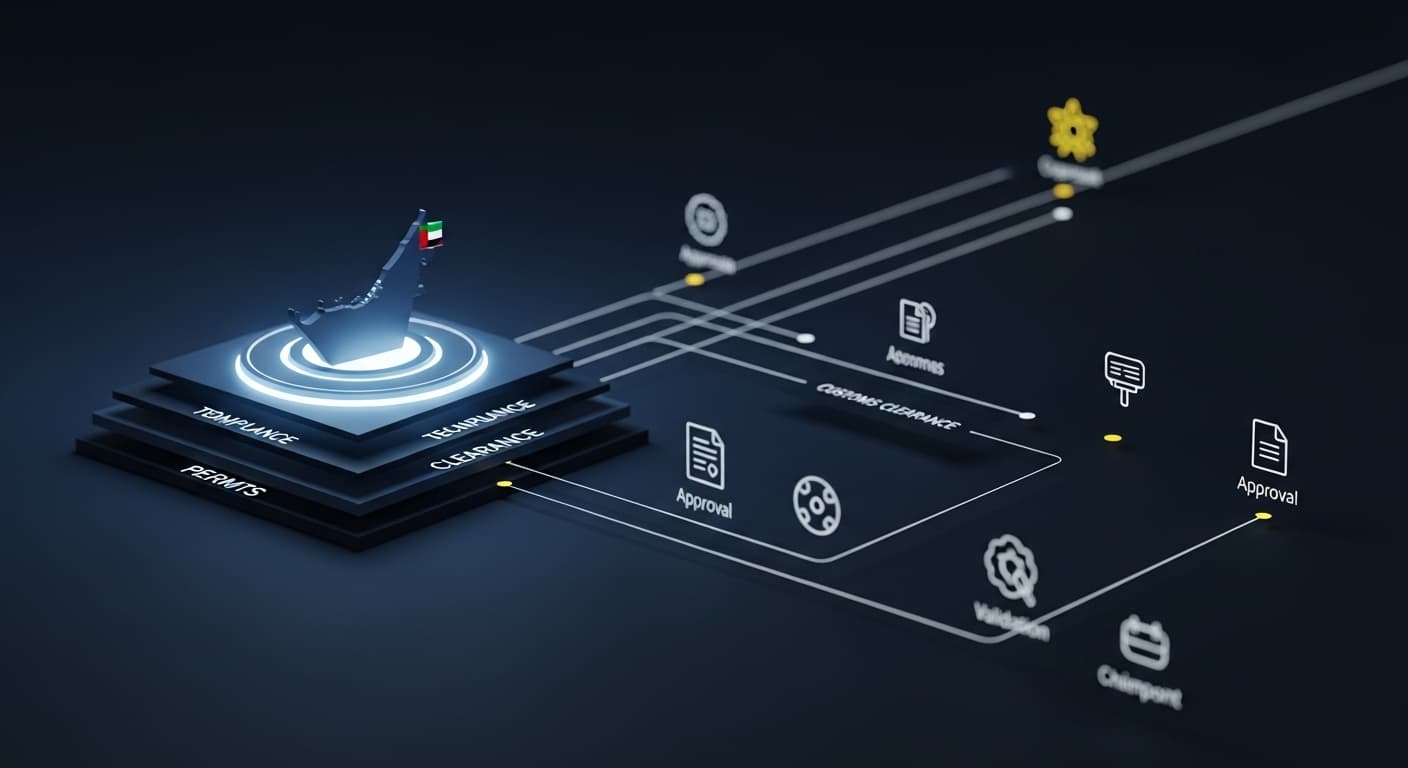
Each device that powers our connected world must first pass the test of regulation — the right approvals, certifications, and documentation that ensure safety, legality, and trust.
Those who understand how these layers intersect don’t just move products; they move industries forward.
That’s the difference between shipping and strategy — where trade compliance becomes the true enabler of global connectivity.
Here's how to navigate the key approvals, certifications, and customs processes that keep technology moving — smoothly, securely, and without disruption. For companies importing regulated tech into the UAE without a local entity, partnering with an Importer of Record for tech equipment ensures full compliance from the moment your shipment leaves the origin.
The UAE stands at the crossroads of global trade — a logistics and data-center powerhouse linking Asia, Europe, and Africa. Its pro-business policies, advanced infrastructure, and zero-tolerance approach to non-compliance make it one of the most efficient import destinations for technology companies worldwide. From the UAE, technology companies frequently expand into neighboring markets. IOR UAE's coverage across the UAE, KSA, Egypt, and Jordan enables unified trade compliance for regional deployments under a single partner.
0 % customs duty on most IT and electronic products (standard 5 % VAT applies).
High demand for telecom, AI, and cloud infrastructure.
World-class digital ecosystems — from Dubai Internet City and Abu Dhabi’s Hub71 to the Smart Dubai initiative.
Several key authorities regulate imports of telecom and IT hardware into the UAE. Together, these entities ensure that all imported tech products meet national safety, connectivity, and trade-compliance requirements:
TDRA (Telecommunications & Digital Government Regulatory Authority) — governs telecom device approvals, frequency use, and network standards.
MoIAT (Ministry of Industry & Advanced Technology) — issues ECAS and EQM conformity certificates for electrical safety.
FCA (Federal Customs Authority) — manages customs declarations, HS-code classification, and valuation under the GCC Common Customs Law.
All devices that connect to public networks — routers, modems, mobile devices, and IoT hardware — must secure TDRA Type Approval.
Products are evaluated under three categories (low, medium, and high risk) based on radio emissions and network impact.
Technical test reports and Declaration of Conformity.
Safety and EMC compliance certificates.
Arabic/English user manuals and product labeling.
The Emirates Conformity Assessment Scheme (ECAS) certifies that electrical and electronic equipment meets UAE safety standards.
To enhance credibility and expedite customs clearance, manufacturers may also obtain the Emirates Quality Mark (EQM).
ECAS → Mandatory for low-voltage and IT devices.
EQM → Voluntary quality mark that demonstrates higher assurance.
To clear UAE customs, products must include:
Bilingual (Arabic + English) labels with conformity logos.
TAR Mark, ECAS/EQM certificate numbers, and importer information.
Supporting documents: Commercial Invoice, Packing List, Certificate of Origin, Trade license, and Declaration of Conformity
Even experienced importers face compliance barriers. The most frequent include:
01.
Delays in TDRA approval or incomplete technical submissions.
02.
Incorrect HS-code classification, triggering revaluation audits.
03.
Missing ECAS/EQM certificates or expired documentation.
04.
Non-compliant labeling or untranslated manuals.
05.
Dual-use technology (encryption, satellite, RF) requiring export-control permits.
06.
Inadequate RMA and reverse logistics planning — Equipment failures that require warranty returns require proper export documentation. Without managing RMA and reverse logistics through an Exporter of Record, returned units face customs holds and VAT disputes.
Note
A single oversight can stall shipments for weeks. Pre-shipment compliance verification, or working with a specialized IOR, eliminates these risks.
For foreign manufacturers or resellers without a UAE entity, an Importer of Record acts as the legally authorized importer. Understanding the difference between IOR and consignee is critical — the consignee receives the goods, but the IOR holds legal import responsibility under UAE law.
The IOR ensures full compliance with UAE customs and regulatory requirements from origin to delivery.
Acting as the licensed importer under UAE law.
Managing duties, VAT, and trade permits.
Handling documentation, approvals, and certifications.
Providing audit-ready records and post-clearance reports.
Example
A global telecom OEM shipped routers into Dubai via an IOR service.
All TDRA and ECAS approvals were pre-validated, and customs clearance was completed within 72 hours — minimizing downtime and storage costs.
The UAE follows the GCC Common Customs Law, applying a 5 % customs duty and 5 % VAT on the CIF value of most goods.
Some high-value IT and data-center equipment may qualify for 0 % duty, depending on classification.
Equipment Type | Customs Duty | VAT | Approval Body |
|---|---|---|---|
Servers | 0–5 % | 5 % | MoIAT / FCA |
Telecom Routers | 5 % | 5 % | TDRA |
AI / IoT Hardware | 5 % | 5 % | TDRA / MoIAT |
Consumer Electronics | 5 % | 5 % | TDRA |
Note:
Imports into free zones such as JAFZA or DAFZA are VAT-exempt if re-exported outside the UAE mainland.
In the UAE, even a small documentation error can result in shipment delays or penalties.
Ensuring a structured, proactive compliance process helps importers maintain control, reduce clearance time, and avoid costly interruptions.
To keep your tech and telecom imports moving seamlessly:
Make sure all telecom and electrical equipment approvals are secured before export.
All invoices, manuals, and labels should be in both Arabic and English to meet inspection standards.
A licensed IOR handles legal import responsibility, customs declarations, and regulatory filings on your behalf.
Accurate classification ensures the correct duty and VAT rate is applied, minimizing audit risks.
Customs operations may run shorter hours during holidays; plan imports accordingly to avoid clearance delays.
In the UAE, successful importing comes down to precision, preparation, and the right expertise.
Every shipment represents a balance between compliance and efficiency — and those who master both keep their technology moving without disruption.
Every shipment represents a balance between compliance and efficiency — and those who master both keep their technology moving without disruption.
With a trusted Importer of Record partner, your business can focus on growth while every detail of customs and regulatory compliance is handled with confidence.
Yes. Wireless, telecom, or network-connected devices require approval from the Telecommunications and Digital Government Regulatory Authority to ensure compliance with national frequency and safety standards.
Clearance generally takes two to four working days once all documentation and certifications are in order. Timing may vary depending on shipment volume and inspection requirements.
These programs confirm that electrical and electronic products meet UAE safety and quality regulations. ECAS is mandatory for most devices, while EQM is optional but often helps accelerate customs processing and builds importer credibility.
Yes. Non-resident businesses can appoint a licensed Importer of Record (IOR) to manage customs filings, pay duties and VAT, and assume legal responsibility for compliance.
Typically required: a commercial invoice, packing list, certificate of origin, conformity or safety certificate, shipping document (Air Waybill/Bill of Lading), and bilingual product labeling or user manual.
Yes, provided they are authentic, fully functional, and compliant with UAE labeling and safety requirements. Customs may request additional inspection or valuation checks before release.
